What Pilot Plant Data Do You Need to Make a Production Scale-Up Decision?
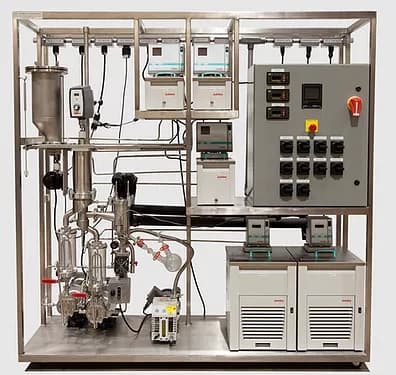
Pilot plant scale-up data is useful when it answers specific production questions: how much material the process can handle while meeting specifications, what operating range is safe to run in, how much evaporator area, vacuum capacity, and condensing capacity a larger system needs, and how many stages the separation requires. The data that answers those questions is not a long list of measurements. It is a set of measured operating conditions, each tied to the product result it produced.
If you need a definition of what a pilot plant is, the existing article on understanding pilot plants covers it. This article covers what to collect once you have one.
Match the Data to the Decision
| Production question | Pilot data that answers it |
| How much can we process per hour and still meet spec? | Feed rate against product quality, recovery, and stability |
| What operating range is safe to run in? | Where quality holds and where it starts to fail, for temperature, pressure, and feed rate |
| How much evaporator area do we need? | Evaporation rate per unit of area at acceptable quality |
| What vacuum and condenser capacity do we need? | Pressure and condenser behavior as vapor load increases |
| How many stages does the separation need? | Whether one pass meets spec, or whether two or three are needed |
| Can we trust the numbers? | Mass balance, repeat runs, run duration |
Capacity and Evaporator Sizing
The first number most teams want is throughput, but the useful version is a curve, not a single point: feed rate on one axis, and product quality and recovery on the other. The highest feed rate the equipment can physically accept is rarely the highest rate at which the product meets specification.
Then convert the results to a rate per unit of evaporator surface area. It is the basis for sizing larger equipment. Do not assume it scales in strict proportion. Our own published nominal ratings for its KD short path series show why: KD-10 (0.10 m², 7 L/hr), KD-30 (0.30 m², 20 L/hr), KD-75 (0.75 m², 50 L/hr), and KD300 (3.00 m², 150 L/hr) work out to roughly 70, 67, 67, and 50 L/hr per square meter. The ratio isn’t constant even across one product family, so measure it on your own feed instead of extrapolating from a number.
Define the Operating Window, Not a Single Setting
A production system should run inside a tested range with margin, not on the edge of what worked once. For each key variable, the pilot should identify:
- The highest feed rate that still meets specification.
- The lowest temperature that gives an acceptable rate.
- The pressure range where quality holds.
- The point where results start to deteriorate, and what the first sign is (color change, off-specification distillate, unstable pressure).
Knowing where performance fails is as valuable as knowing where it succeeds. It tells operators what to watch for and how much margin the production design should leave.
Heat, Vacuum, and Vapor Handling
These three drive the size of the supporting equipment, and one set of runs can inform all of them.
- Heat: Record the heating temperature needed at each feed rate. If temperature has to rise sharply to keep up with a modest feed increase, the evaporator area or heat input is the constraint.
- Vacuum: Record how pressure changes as feed rate and temperature rise. A pressure that climbs quickly with vapor load indicates that the vacuum system or condenser will need more capacity at scale.
- Condensing: Record coolant temperature and whether collection stays clean as vapor load increases.
Our pilot service lists upgrade options such as increasing evaporator size, moving from a medium to a high vacuum system, and adding stages. Those are the same three decisions pilot data should inform.
Test Whether One Pass Is Enough
A common pilot finding is that one pass doesn’t achieve the target purity or recovery. If a second or third stage brings it to specification, that changes the production configuration, not just the operating settings.
Our tolling capacity data is based on three-stage systems (KD-10 at 15 kg/hr, KD-30 at 45 kg/hr, and KD-150 at 225 kg/hr). Whether your process needs multiple stages is a decision the pilot should settle before equipment is specified.
Tie Quality to Conditions and Close the Mass Balance
For every stable condition, sample both distillate and residue and analyze them against your specification. Our analytical lab lists GC-MS, GC-FID with simulated distillation, HPLC, auto titration, Karl Fischer titration, viscosity, and turbidity capability, which shows the range of tests worth planning for.
Then check the mass balance: does the feed you put in reasonably equal what came out as distillate, residue, trapped material, and samples? A large gap means either a measurement problem or material loss you don’t yet understand. Fix it before treating any result as a design basis.
Run Long Enough to See Drift
A short run can hide problems that appear in production: gradual fouling, a slow pressure rise, or a drop in distillate rate over hours. Extend at least some runs long enough to see whether the process holds its condition, and use more than one lot of feed to see how much lot-to-lot variation the design must tolerate.
Know What the Pilot Can’t Tell You
Pilot data supports engineering decisions but doesn’t replace them. Heat transfer, flow distribution, vapor handling, and controls can behave differently as equipment gets larger, so treat the data as a design basis that still needs engineering review. Note in the report which findings are firm, which are estimates, and what still needs testing.
Turning Data Into a Decision
A useful summary for engineering, operations, quality, and finance shows the measured capacity range, the recommended operating window, the vacuum, heat, and condensing requirements, the stage count, the mass balance, and what remains uncertain. A clear statement of the open risks makes the capital request more credible than a summary that only shows the best runs.
Two Ways to Get the Data
At Chemtech, we offer two routes. Pilot plant fabrication builds custom equipment around your process when standard units won’t reproduce the conditions you need, with options for modifying stages, vacuum level, and evaporator size as needs grow. Toll distillation lets you run commercial quantities through Chemtech’s multi-stage stainless units and gather data without buying equipment. The choice depends on whether your process fits the fixed toll configurations or needs a custom setup.
Frequently Asked Questions
What if pilot results and lab results disagree?
Compare the conditions before assuming either is wrong. Different heat-transfer surfaces, residence times, vapor loads, and condenser arrangements between a lab unit and a pilot unit can produce different results. Identify which conditions changed, then decide which result better represents production.
Should the pilot feed match what production will use?
As closely as possible, and include a worst case. A clean, well-behaved sample can produce data that a real production feed won’t repeat. If production feed varies by lot, test at the extremes.
How many runs are enough?
There is no fixed number. Stop when the operating window’s boundaries are identified, results repeat across runs and lots, the mass balance closes, and at least one run is long enough to show drift. If any of those is still uncertain, run more.
Is toll distillation data as useful as data from a custom pilot plant?
We position tolling data as a way to gain certainty about scaled designs. It works best when your process suits the available multi-stage configurations. If your process needs conditions those units can’t provide, a custom pilot is the better route.
Tags: Commercial Plant Design Data, Pilot Plant Process Validation, pilot plant scale-up data