Posted by Chemtech Services on August 29, 2026
A serious distillation equipment manufacturer should provide component-level operating manuals, training built around your actual feed material, industry-specific compliance documentation, and a clear point of contact for technical questions after installation. Buyers who only confirm “a manual and a warranty” often discover, too late, that neither one answers the question they actually have. Buying a […]
Posted by Chemtech Services on August 22, 2026
Alloy price volatility can raise distillation equipment quotes, but the effect depends on the specific material grade required, how much of it the system needs, and how customized the configuration is. Standard stainless-steel systems are generally less exposed to price swings than systems built with specialty alloys like Hastelloy or Inconel. There’s no single percentage […]
Posted by Chemtech Services on August 15, 2026
A specification sheet tells you what a distillation system is capable of in general terms. Existing process data tells you how your specific material will behave inside that system. Feed composition, thermal sensitivity, viscosity, boiling range, and prior run results all shape equipment selection in ways a standard capacity chart can’t predict. Most buyers start […]
Posted by Chemtech Services on August 8, 2026
Short path distillation offers reduced thermal exposure, short residence time, and better protection for heat-sensitive materials, but only if the system maintains stable operating conditions from batch to batch. A PLC helps hold temperature, feed rate, and sequencing steady without relying on an operator to repeat settings manually. Manual operation can achieve the same consistency, […]
Posted by Chemtech Services on August 1, 2026
High-vacuum distillation can be relevant for epoxy resins and certain acrylic materials when residual solvents, unreacted components, or low-boiling impurities need to be removed without exposing the material to excessive heat. Whether short path distillation is the right fit depends on the specific formulation’s viscosity, thermal stability, and boiling behavior, not on the general material […]
Posted by Chemtech Services on July 30, 2026
Engineers set rolled film distillation operating conditions by working outward from the material’s limits: the highest temperature the product tolerates, the vacuum level the system can hold, and the purity or recovery the product has to meet. Inside those limits, they start with a conservative feed rate and temperature, then change one variable at a […]
Posted by Chemtech Services on July 23, 2026
A falling film distillation system is usually the right fit when the job is removing a large volume of volatile liquid from a feed that flows freely and doing it continuously. Typical examples are solvent recovery, removing volatile organics, and concentrating liquids. It is usually a weaker fit when the target is a high-boiling, heat-fragile […]
Posted by Chemtech Services on July 16, 2026
When a short path distillation system won’t reach its vacuum or can’t hold it, the pump is rarely the first thing to check. Troubleshooting works best as a sequence that splits the problem in half at each step: is it the measurement or the system, the system or the process, the leak or the vapor […]
Posted by Chemtech Services on July 7, 2026
Pilot plant scale-up data is useful when it answers specific production questions: how much material the process can handle while meeting specifications, what operating range is safe to run in, how much evaporator area, vacuum capacity, and condensing capacity a larger system needs, and how many stages the separation requires. The data that answers those […]
Posted by Lucas Widdes on August 20, 2024
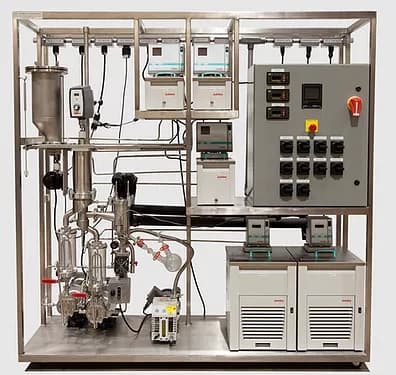
At Chemtech Services Inc., we specialize in manufacturing distillation equipment for labs of all sizes, and we’re committed to supporting you every step of the way. In this blog, we’ll explore what a pilot plant is, how to set one up, and the equipment you might need.